.svg)
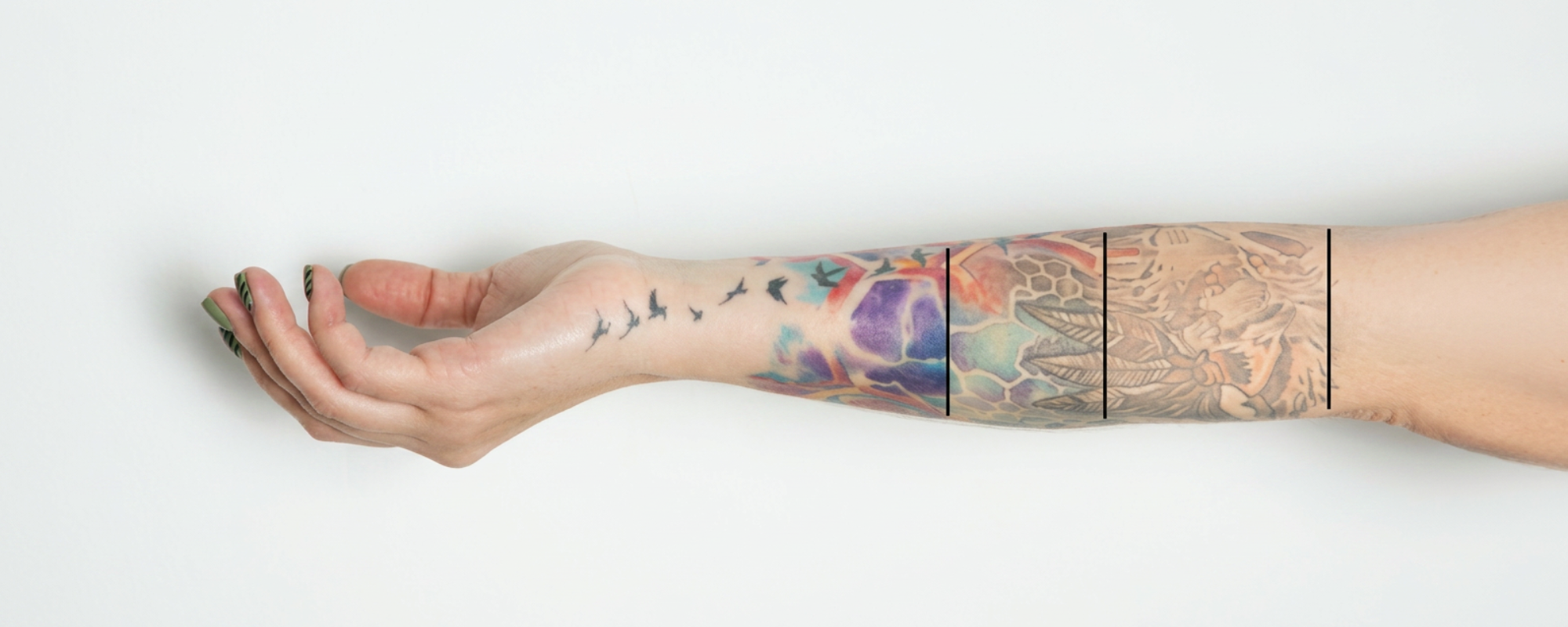
If you're staring at a tattoo you're ready to be done with, you've probably already googled "how many sessions does laser tattoo removal take" more than once. And you've probably gotten a different answer every time.
That's because there isn't one number that applies to everyone. But there is a clear, predictable process behind it — and once you understand what's actually happening session by session, the timeline makes a lot more sense.
Let's walk through it.
Before diving into the timeline, if you've been wondering what the treatment actually feels like session to session, our honest look at whether laser tattoo removal hurts answers that first.
We wish we could give you a single, tidy number. We can't — and honestly, any provider who promises an exact session count before even seeing your tattoo isn't being fully straight with you.
What we can tell you is that most tattoos take somewhere between 6 and 12 sessions to fade significantly or fully clear, depending on a handful of predictable factors. The goal of this post is to walk you through exactly what those factors are, so you can get a realistic sense of your own timeline — not just a generic average.
A few key things shape how many sessions your laser tattoo removal journey will take:
If you're curious what each session actually feels like along the way, we cover that in detail in does laser tattoo removal hurt
Here's a general framework — not a guarantee, but a realistic starting point:
Tattoo Type
Typical Session Range
Small, solid black ink
4–6 sessions
Medium, single-color tattoo
6–8 sessions
Large or multi-color tattoo
8–12+ sessions
Cover-up or layered tattoo
10–15+ sessions
Professional ink, dense saturation
More sessions than amateur/hand-poked tattoos
The biggest takeaway: simpler, darker, less saturated tattoos clear fastest. Bigger, brighter, more layered tattoos take patience.
It's tempting to want to speed things up by scheduling sessions closer together. But the spacing isn't arbitrary — it's actually the most important part of the process.
Each session breaks the tattoo ink into smaller fragments. Then your immune system spends the next several weeks slowly clearing those fragments out through your lymphatic system. That's why sessions are spaced 4–6 weeks apart — it gives your body the time it needs to actually do its job. Treating too soon doesn't speed up results; it just increases the risk of irritation without adding any benefit.
Progress isn't always dramatic from one session to the next, and that's normal. Here's roughly what to expect:
If you find yourself discouraged mid-process, that's incredibly common — and almost always a sign you're right on track, not behind.
Some tattoos are simply easier to remove than others:
Faster-responding tattoos:
Slower-responding tattoos:
This doesn't mean a stubborn tattoo can't be removed — it just means the timeline will run longer, and that's worth knowing upfront rather than being surprised by later.
Every tattoo removal journey starts with a consultation where we look at your specific tattoo — ink colors, size, location, and skin tone — and give you an honest, personalized estimate rather than a generic number.
We use the Harmony XL Pro, which is effective across a broader range of ink colors and skin tones than many older systems, and we check in on your progress at every visit so you always know where you stand and what's realistic for your next session. If you want the bigger picture on how the technology itself works, we cover that in how laser tattoo removal works .
We also offer flexible financing options to help make a multi-session process more manageable.

If you've been sitting on tattoo regret and wondering when to finally start removal, timing matters more than you'd think. This guide explains why cooler months give you the advantage, how sun exposure affects your results, and what starting now sets you up for by the time summer rolls around. Learn how to plan your removal journey around the seasons at Wasatch Advanced Wellness in Payson, Utah.
Read the Full Blog: Tattoo Regret? Why Fall and Winter Are the Best Times to Start Removal
Monday-Thursday: 9am to 5pm
Evening appointments available
Friday: By Appointment
Saturday: By Appointment
Sunday: Closed

Wasatch Advanced Wellness
© 2024 Wasatch Advanced Wellness