🍂 Fall Specials — Free medium area with large LHR package · Free jelly mask with IPL · Free mini facial with ClearLift. Book by November 30. Book Now →

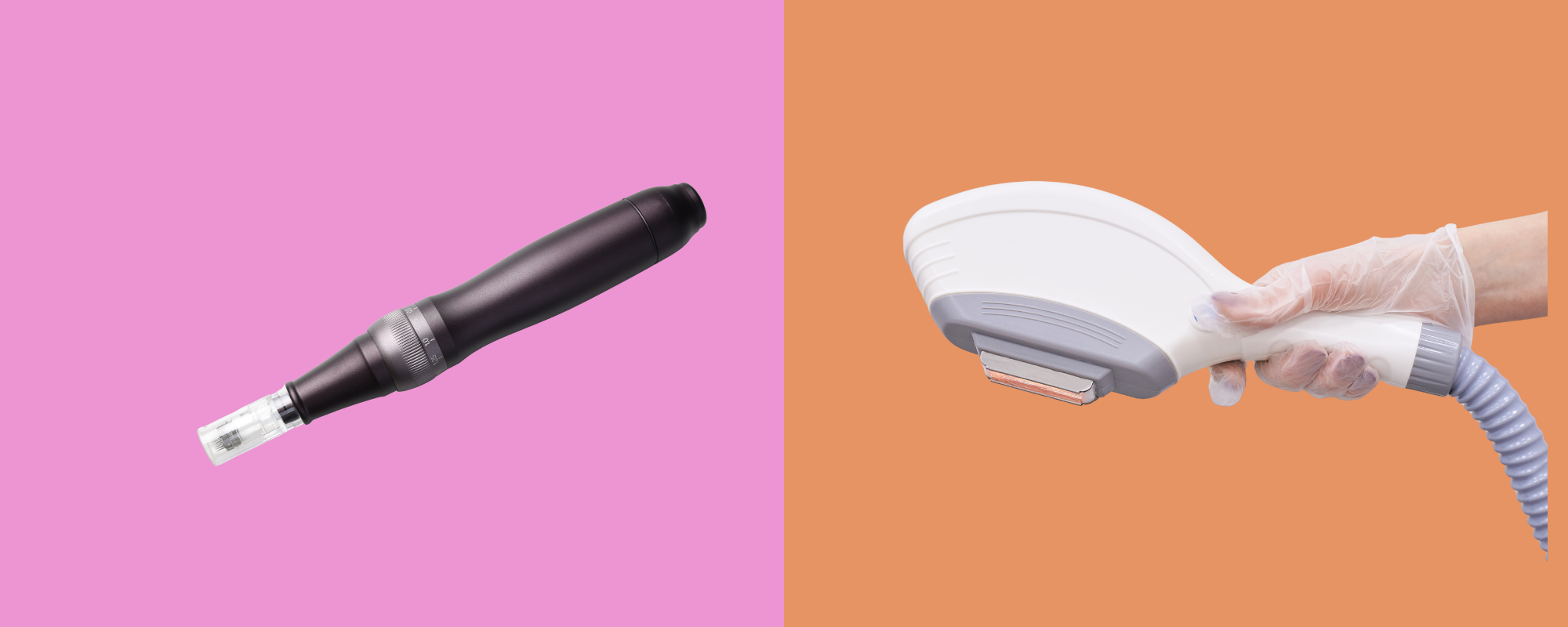
You have pigmentation you want to address — sun spots, dark spots left from old breakouts, uneven tone that foundation can't quite cover — and you've narrowed it down to two treatments: IPL photofacial and microneedling. Both get mentioned in the same breath when it comes to skin tone and pigmentation. Both are available at Wasatch Advanced Wellness. And you're not sure which one actually makes more sense for your specific situation.
The answer isn't always one or the other — but understanding how they work differently, what each one is actually best at, and when combining them makes sense will help you walk into a consultation knowing exactly what to ask.
Before comparing treatments it helps to understand why pigmentation forms — because not all pigmentation is the same, and the type you have influences which treatment will work better.
Pigmentation occurs when melanocytes — the cells responsible for producing melanin, your skin's pigment — become overactive in certain areas. The trigger varies:
The depth and cause of your pigmentation matters because IPL and microneedling target pigmentation through completely different mechanisms — and one works better for surface-level pigmentation while the other is more effective for deeper, more complex concerns.
IPL stands for Intense Pulsed Light. It works by delivering broad-spectrum light energy into the skin — and melanin, the pigment responsible for dark spots, absorbs that light energy selectively.
When melanin absorbs the light, it heats up and breaks down. The fragmented pigment particles are then processed by your immune system and gradually cleared from the skin. At the surface, pigmented spots often darken first — turning slightly brown or grey — before flaking off over the following days as the treated pigment is shed. This is normal and a sign the treatment is working.
IPL is essentially a direct, targeted approach to pigmentation — it goes after the melanin itself rather than working indirectly through skin renewal. This makes it faster and more precise for clearly defined, surface-level pigmentation. A single IPL session can produce visible results within one to two weeks as treated pigment sheds.
IPL also addresses redness, rosacea, and broken capillaries in the same session — because hemoglobin (the pigment in red blood cells) also absorbs IPL energy selectively. For patients with both pigmentation and redness concerns, IPL treats both simultaneously.
Microneedling works through a fundamentally different mechanism — it doesn't target melanin directly at all.
Instead, microneedling creates thousands of controlled micro-channels in the skin that trigger your body's natural healing response. That response includes accelerated cell turnover — your skin produces new cells faster, which brings fresh, more evenly pigmented skin to the surface while pushing pigmented cells out.
Over multiple sessions, this progressive renewal gradually fades pigmentation as the skin's surface is replaced with healthier, more evenly pigmented tissue. The collagen and elastin produced during healing also improve overall skin quality — texture, firmness, and radiance — which makes remaining pigmentation less visible even before it fully fades.
Microneedling is a slower, more indirect approach to pigmentation than IPL — but it's working on the broader skin environment rather than targeting individual spots. This makes it more appropriate for diffuse, deep, or complex pigmentation where a direct light-based approach isn't sufficient or appropriate.
...
IPL Photofacial
Microneedling
How it works
Light energy directly breaks down melanin
Accelerated cell turnover gradually replaces pigmented cells
Speed of results
Faster — visible improvement within 1–2 weeks of first session
Slower — improvement builds over multiple sessions
Best pigmentation type
Defined surface spots, sun damage, age spots, redness
Diffuse uneven tone, PIH, deeper pigmentation, overall skin quality
Treats redness too?
Yes — addresses rosacea and broken capillaries simultaneously
No direct effect on redness
Downtime
Minimal — pigmented spots darken then shed over 1–2 weeks
1–3 days of redness and mild swelling
Sessions typically needed
3–5 for significant improvement
3–6 depending on concern depth
Skin tone considerations
More caution needed for darker skin tones
Generally safe across all skin tones
Melasma
Requires caution — can worsen melasma
Can help with careful, conservative treatment
Overall skin quality
Improves tone and texture indirectly
Strong direct improvement in texture, firmness, pore size
Best combined with
Microneedling for comprehensive results
IPL for faster pigmentation clearance
IPL tends to be the stronger primary treatment when:
Your pigmentation is clearly defined and surface-level. Sun spots, age spots, and freckles that sit near the surface of the skin are exactly what IPL is designed for. The direct melanin-targeting approach is faster and more precise for these concerns than microneedling's indirect cell-turnover mechanism.
You also have redness or rosacea. IPL's ability to simultaneously address both pigmentation and vascular concerns in one session makes it the more efficient choice for patients dealing with both.
You want faster visible results. IPL typically produces visible pigmentation improvement within one to two weeks of the first session as treated spots shed. Microneedling improvement is more gradual. For patients who want to see something happen quickly, IPL delivers faster early feedback.
Your skin concern is primarily pigmentation rather than texture or scarring. If your main complaint is dark spots on otherwise smooth skin, IPL is usually the more targeted and efficient starting point.
Microneedling tends to be the stronger primary treatment when:
Your pigmentation is diffuse or deeper in the skin. Post-inflammatory hyperpigmentation from old acne and deeper pigmentation that doesn't sit right at the surface responds better to microneedling's progressive cell-turnover approach than to IPL's surface-targeting light energy.
You have darker skin. IPL carries a higher risk of post-inflammatory hyperpigmentation in patients with more melanin — meaning the treatment itself can potentially cause the problem it's trying to fix. Microneedling is generally safer across all skin tones and is the more appropriate starting point for patients with medium to dark complexions.
Pigmentation is accompanied by texture, scarring, or enlarged pores. If your skin concern is a combination of uneven tone and compromised texture, microneedling addresses both simultaneously. IPL improves tone but has limited direct effect on texture and scarring.
You have melasma. IPL can worsen melasma by triggering melanocyte activity with light energy. Microneedling, used conservatively, is generally the safer option for melasma patients — though both require careful consideration and provider expertise.
For many patients the real answer to "IPL or microneedling" is both — sequenced appropriately over time.
The combination works particularly well because they address pigmentation through complementary mechanisms:
This sequence is especially effective for patients with:
Timing matters — the two treatments shouldn't be done on the same day or too close together. IPL first, then microneedling at least two to four weeks later, gives each treatment the space to work without overwhelming the skin. Our full guide to treatment combinations covers timing and sequencing in more detail.
...
IPL
Microneedling
After session 1
Pigmented spots darken, then shed within 1–2 weeks
Redness for 1–3 days, subtle early improvement
After session 2–3
Significant visible improvement in spots and tone
Noticeable improvement in tone and texture beginning
After full series
Most surface pigmentation cleared or significantly faded
Meaningful improvement in overall skin quality, diffuse pigmentation faded
Improvement after final session
Moderate
Yes — collagen remodeling continues for 3–6 months
Maintenance
1–2 sessions per year for sun-exposed patients
1–2 sessions per year depending on goals
At Wasatch Advanced Wellness, pigmentation consultations and treatment planning are led by Mckayla Mangelson, Master Aesthetician — and her starting point is always the same: actually looking at your skin before recommending anything.
During your consultation, Mckayla evaluates the type, depth, and distribution of your pigmentation, your skin tone, your history with previous treatments, and your goals — then builds a plan that makes sense for your specific situation. For some patients that means starting with IPL. For others it means microneedling. For many it means a sequenced combination of both over time.
For patients whose pigmentation has a hormonal component — melasma or pigmentation changes related to perimenopause, menopause, or hormonal imbalance — Chelsa Bringhurst, FNP-BC may also be involved in care, since hormonal changes directly influence melanocyte activity and can undermine aesthetic treatment results if not addressed alongside them.
You can explore both treatments individually on our IPL photofacial and microneedling pages — or come in for a consultation and let Mckayla look at your skin directly. Book a skin consultation at Wasatch Advanced Wellness and get a real answer about what your pigmentation actually needs.
Monday-Thursday: 9am to 5pm
Evening appointments available
Friday: By Appointment
Saturday: By Appointment
Sunday: Closed

Wasatch Advanced Wellness
© 2026 Wasatch Advanced Wellness